
实现动物专家系统#
来自 AI for Beginners Curriculum 的示例。
在此示例中,我们将实现一个简单的基于知识的系统,根据一些物理特征来确定动物。该系统可以用以下 AND-OR 树表示(这是整个树的一部分,我们可以很容易地添加更多规则):
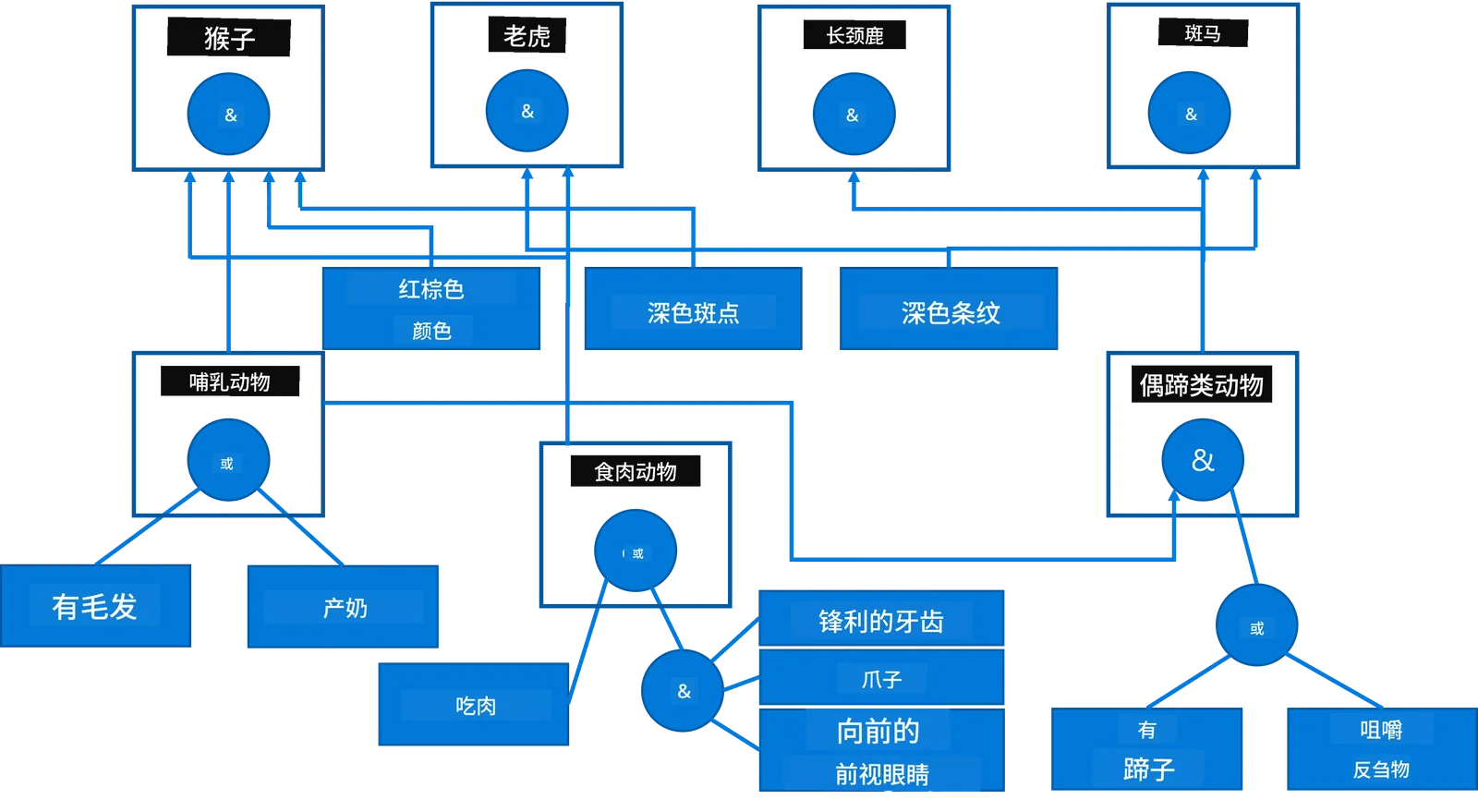
我们自己的带有逆向推理的专家系统外壳#
让我们尝试定义一个基于产生规则的简单知识表示语言。我们将使用 Python 类作为关键字来定义规则。基本上将有三种类型的类:
Ask表示需要向用户提出的问题。它包含可能的答案集合。If表示一个规则,它只是存储规则内容的语法糖AND/OR是表示树的 AND/OR 分支的类。它们只存储内部的参数列表。为简化代码,所有功能都定义在父类Content中。
class Ask():
    def __init__(self,choices=['y','n']):
        self.choices = choices
    def ask(self):
        if max([len(x) for x in self.choices])>1:
            for i,x in enumerate(self.choices):
                print("{0}. {1}".format(i,x),flush=True)
            x = int(input())
            return self.choices[x]
        else:
            print("/".join(self.choices),flush=True)
            return input()

class Content():
    def __init__(self,x):
        self.x=x

class If(Content):
    pass

class AND(Content):
    pass

class OR(Content):
pass在我们的系统中,工作记忆将包含作为属性-值对的事实列表。知识库可以定义为一个大型字典,将动作(应插入工作记忆的新事实)映射到以与或表达式表示的条件。此外,某些事实可以被Ask。
rules = {
    'default': Ask(['y','n']),
    'color' : Ask(['red-brown','black and white','other']),
    'pattern' : Ask(['dark stripes','dark spots']),
    'mammal': If(OR(['hair','gives milk'])),
    'carnivor': If(OR([AND(['sharp teeth','claws','forward-looking eyes']),'eats meat'])),
    'ungulate': If(['mammal',OR(['has hooves','chews cud'])]),
    'bird': If(OR(['feathers',AND(['flies','lies eggs'])])),
    'animal:monkey' : If(['mammal','carnivor','color:red-brown','pattern:dark spots']),
    'animal:tiger' : If(['mammal','carnivor','color:red-brown','pattern:dark stripes']),
    'animal:giraffe' : If(['ungulate','long neck','long legs','pattern:dark spots']),
    'animal:zebra' : If(['ungulate','pattern:dark stripes']),
    'animal:ostrich' : If(['bird','long nech','color:black and white','cannot fly']),
    'animal:pinguin' : If(['bird','swims','color:black and white','cannot fly']),
    'animal:albatross' : If(['bird','flies well'])
}
为了执行向后推理,我们将定义 Knowledgebase 类。它将包含:
- 工作的
memory—— 一个将属性映射到值的字典 - 知识库中的
rules,格式如上文所定义
两个主要方法是:
get用于获取属性的值,必要时执行推理。例如,get('color')会获取颜色槽的值(如有必要会询问,并将值存储以备后续使用在工作内存中)。如果我们调用get('color:blue'),它会询问颜色,然后根据颜色返回y/n值。eval执行实际推理,即遍历 AND/OR 树,评估子目标等。
class KnowledgeBase():
    def __init__(self,rules):
        self.rules = rules
        self.memory = {}

    def get(self,name):
        if ':' in name:
            k,v = name.split(':')
            vv = self.get(k)
            return 'y' if v==vv else 'n'
        if name in self.memory.keys():
            return self.memory[name]
        for fld in self.rules.keys():
            if fld==name or fld.startswith(name+":"):
                # print(" + proving {}".format(fld))
                value = 'y' if fld==name else fld.split(':')[1]
                res = self.eval(self.rules[fld],field=name)
                if res!='y' and res!='n' and value=='y':
                    self.memory[name] = res
                    return res
                if res=='y':
                    self.memory[name] = value
                    return value
        # field is not found, using default
        res = self.eval(self.rules['default'],field=name)
        self.memory[name]=res
        return res

    def eval(self,expr,field=None):
        # print(" + eval {}".format(expr))
        if isinstance(expr,Ask):
            print(field)
            return expr.ask()
        elif isinstance(expr,If):
            return self.eval(expr.x)
        elif isinstance(expr,AND) or isinstance(expr,list):
            expr = expr.x if isinstance(expr,AND) else expr
            for x in expr:
                if self.eval(x)=='n':
                    return 'n'
            return 'y'
        elif isinstance(expr,OR):
            for x in expr.x:
                if self.eval(x)=='y':
                    return 'y'
            return 'n'
        elif isinstance(expr,str):
            return self.get(expr)
        else:
            print("Unknown expr: {}".format(expr))
现在让我们定义我们的动物知识库并进行咨询。请注意,此调用会向您提问。您可以通过输入 y/n 来回答是非题,或者通过指定数字(0..N)来回答具有多个选项的题目。
kb = KnowledgeBase(rules)
kb.get('animal')
hair
y/n
sharp teeth
y/n
claws
y/n
forward-looking eyes
y/n
color
0. red-brown
1. black and white
2. other
has hooves
y/n
long neck
y/n
long legs
y/n
pattern
0. dark stripes
1. dark spots
'giraffe'使用 Experta 进行正向推理#
在下一个示例中,我们将尝试使用用于知识表示的库之一 Experta 实现正向推理。Experta 是一个用于在 Python 中创建正向推理系统的库,其设计类似于经典的旧系统 CLIPS。
我们本来也可以自己实现正向链式推理而不会有太大问题,但简单的实现通常效率不高。为了更有效地进行规则匹配,使用了一种特殊算法 Rete。
import sys
!{sys.executable} -m pip install git+https://github.com/nilp0inter/experta
Collecting git+https://github.com/nilp0inter/experta
Cloning https://github.com/nilp0inter/experta to /tmp/pip-req-build-7qurtwk3
Running command git clone --filter=blob:none --quiet https://github.com/nilp0inter/experta /tmp/pip-req-build-7qurtwk3
Resolved https://github.com/nilp0inter/experta to commit c6d5834b123861f5ae09e7d07027dc98bec58741
Installing build dependencies ... [?25ldone
[?25h Getting requirements to build wheel ... [?25ldone
[?25h Preparing metadata (pyproject.toml) ... [?25ldone
[?25hRequirement already satisfied: frozendict~=2.4.6 in /opt/conda/envs/ai4beg/lib/python3.12/site-packages (from experta==1.9.5.dev1) (2.4.7)
Collecting schema~=0.6.7 (from experta==1.9.5.dev1)
Downloading schema-0.6.8-py2.py3-none-any.whl.metadata (14 kB)
Downloading schema-0.6.8-py2.py3-none-any.whl (14 kB)
Building wheels for collected packages: experta
Building wheel for experta (pyproject.toml) ... [?25ldone
[?25h Created wheel for experta: filename=experta-1.9.5.dev1-py3-none-any.whl size=34804 sha256=888c459512a5e713f4b674caa9a0f96cfdf07ec0d6eb56cc318ce0653d218014
Stored in directory: /tmp/pip-ephem-wheel-cache-1eeii9zy/wheels/3d/e8/bb/22d7956359603fa8dd679aa09f5b8efb3f29991c3986fdc787
Successfully built experta
Installing collected packages: schema, experta
[2K [90m━━━━━━━━━━━━━━━━━━━━━━━━━━━━━━━━━━━━━━━━[0m [32m2/2[0m [experta]
[1A[2KSuccessfully installed experta-1.9.5.dev1 schema-0.6.8
from experta import *
#import experta
我们将把系统定义为一个继承自 KnowledgeEngine 的类。每条规则由一个带有 @Rule 注解的单独函数定义,该注解指定规则何时触发。在规则内部,我们可以使用 declare 函数添加新的事实,添加这些事实将导致前向推理引擎调用更多规则。
class Animals(KnowledgeEngine):
    @Rule(OR(
           AND(Fact('sharp teeth'),Fact('claws'),Fact('forward looking eyes')),
           Fact('eats meat')))
    def cornivor(self):
        self.declare(Fact('carnivor'))

    @Rule(OR(Fact('hair'),Fact('gives milk')))
    def mammal(self):
        self.declare(Fact('mammal'))

    @Rule(Fact('mammal'),
          OR(Fact('has hooves'),Fact('chews cud')))
    def hooves(self):
        self.declare('ungulate')

    @Rule(OR(Fact('feathers'),AND(Fact('flies'),Fact('lays eggs'))))
    def bird(self):
        self.declare('bird')

    @Rule(Fact('mammal'),Fact('carnivor'),
          Fact(color='red-brown'),
          Fact(pattern='dark spots'))
    def monkey(self):
        self.declare(Fact(animal='monkey'))

    @Rule(Fact('mammal'),Fact('carnivor'),
          Fact(color='red-brown'),
          Fact(pattern='dark stripes'))
    def tiger(self):
        self.declare(Fact(animal='tiger'))

    @Rule(Fact('ungulate'),
          Fact('long neck'),
          Fact('long legs'),
          Fact(pattern='dark spots'))
    def giraffe(self):
        self.declare(Fact(animal='giraffe'))

    @Rule(Fact('ungulate'),
          Fact(pattern='dark stripes'))
    def zebra(self):
        self.declare(Fact(animal='zebra'))

    @Rule(Fact('bird'),
          Fact('long neck'),
          Fact('cannot fly'),
          Fact(color='black and white'))
    def straus(self):
        self.declare(Fact(animal='ostrich'))

    @Rule(Fact('bird'),
          Fact('swims'),
          Fact('cannot fly'),
          Fact(color='black and white'))
    def pinguin(self):
        self.declare(Fact(animal='pinguin'))

    @Rule(Fact('bird'),
          Fact('flies well'))
    def albatros(self):
        self.declare(Fact(animal='albatross'))

    @Rule(Fact(animal=MATCH.a))
    def print_result(self,a):
          print('Animal is {}'.format(a))

    def factz(self,l):
        for x in l:
            self.declare(x)
一旦我们定义了知识库,我们就用一些初始事实来填充工作内存,然后调用 run() 方法来执行推理。结果你可以看到,新的推断事实被添加到工作内存中,包括关于动物的最终事实(如果我们正确设置了所有初始事实)。
ex1 = Animals()
ex1.reset()
ex1.factz([
    Fact(color='red-brown'),
    Fact(pattern='dark stripes'),
    Fact('sharp teeth'),
    Fact('claws'),
    Fact('forward looking eyes'),
    Fact('gives milk')])
ex1.run()
ex1.facts
Animal is tiger
FactList([(0, InitialFact()),
          (1, Fact(color='red-brown')),
          (2, Fact(pattern='dark stripes')),
          (3, Fact('sharp teeth')),
          (4, Fact('claws')),
          (5, Fact('forward looking eyes')),
          (6, Fact('gives milk')),
          (7, Fact('mammal')),
          (8, Fact('carnivor')),
(9, Fact(animal='tiger'))])免责声明:
本文件已使用人工智能翻译服务Co-op Translator进行翻译。尽管我们力求准确,但请注意,自动翻译可能存在错误或不准确之处。请以原始语言的原文件为权威来源。对于重要信息,建议采用专业人工翻译。我们不对因使用本翻译而产生的任何误解或误释承担责任。